
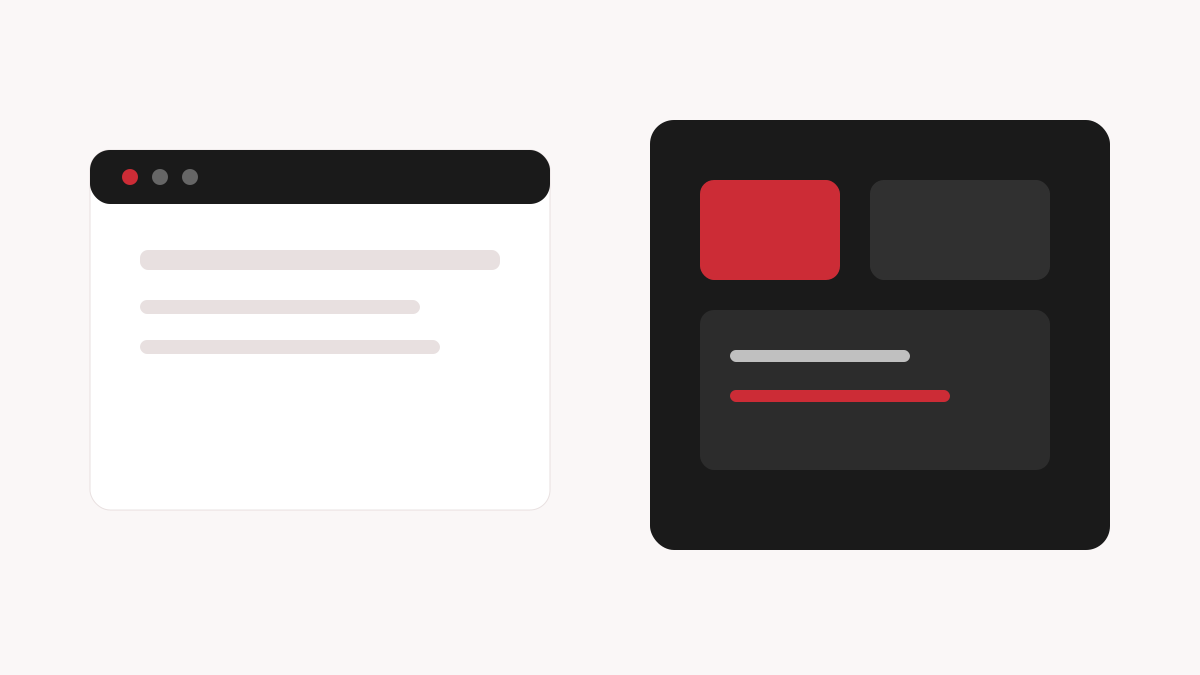
Navigating the Confusion of Digital Presence
In today's digital-first landscape, establishing an online presence is absolutely non-negotiable for businesses of all sizes and industries. However, business owners and stakeholders often use the terms "website" and "web application" interchangeably in casual conversation. While they both exist on the internet and are accessed via web browsers, technically and fundamentally, they are entirely different entities serving vastly different purposes.
This widespread confusion frequently leads to misaligned expectations, inaccurate project estimations, and sometimes, businesses investing in the wrong type of technological solution. Understanding the core structural and functional differences between the two is a critical first step when deciding what digital asset to build to support your specific business goals.
What Exactly is a Website?
At its core, a website is primarily informational in nature. Its main purpose is to display static content—such as text, images, videos, and company information—to the visiting user. You can think of a traditional website as an interactive, digital brochure or a storefront window.
Even if a website is built on a Content Management System (CMS) like WordPress, allowing administrators to easily update blog posts or add new pages without coding, the experience for the end-user remains largely the same. The content is essentially static for the visitor; they read the "About Us" page, browse the list of services, read a blog post, and perhaps fill out a simple contact form. Websites are absolutely perfect for establishing brand identity, sharing company news, building search engine authority, and providing essential contact information to the public.
What Exactly is a Web Application?
A web application, on the other hand, is defined by its interactivity and its ability to process complex data. It is a piece of software that runs in the browser. Instead of merely consuming written content, users actively utilize a web application to perform specific tasks, manipulate data, and complete complex workflows.
Web applications require users to input information, which the application then processes in a backend database, often returning a customized result based on that specific user's input and their account permissions. Examples include online banking portals where you transfer funds, robust e-commerce dashboards where you manage inventory and track shipments, or internal employee management systems. If your project requires sophisticated logic, user authentication, data processing, and complex interactions, you are looking at custom web application development, not just website design.
The Technological Underpinnings
The difference between the two is also reflected heavily in how they are constructed. Websites are typically built using standard markup languages like HTML, CSS, and basic JavaScript. They might be powered by a CMS like WordPress or Webflow, which handles the content rendering efficiently. Because their primary job is to deliver pre-written content, the server simply fetches the requested page and sends it to the user's browser.
Web applications, however, are vastly more complex under the hood. They are built using robust programming frameworks and languages such as React, Angular, Node.js, Python, or Laravel. They rely heavily on sophisticated backend databases (like PostgreSQL or MongoDB) to constantly read, write, and manipulate data based on the user's immediate actions. When a user clicks a button in a web application, the server runs complex logic, validates permissions, updates the database, and dynamically generates a completely custom response.
Scalability and Future-Proofing
When investing in digital infrastructure, you must consider long-term scalability. Scaling a website usually means adding more pages, publishing more blog posts, or upgrading your hosting server to handle higher traffic volumes. It is a relatively straightforward process. Scaling a web application is a much more intricate engineering challenge. It involves optimizing database queries, implementing caching layers to ensure the application remains lightning-fast under heavy load, and ensuring the complex backend architecture can handle simultaneous transactions securely without crashing.
Core Differences at a Glance
To help clarify the distinction, here is a breakdown of the primary differences between the two digital formats:
| Feature | Website | Web Application |
|---|---|---|
| Primary Function | Informational (Displaying content to the public) | Interactive (Performing specific tasks and data processing) |
| User Interaction | Low (Reading content, clicking links, submitting simple forms) | High (Inputting data, processing transactions, managing dashboards) |
| Authentication | Rarely required (Usually public access for all visitors) | Often strictly required (Secure user login, diverse role-based profiles) |
| Complexity & Logic | Relatively simple front-end presentation | Highly complex, requiring robust backend programming and database logic |
| Development Cost & Time | Generally lower cost and faster deployment timeline | Higher investment, requiring rigorous testing and longer development cycles |
What Does Your Business Actually Need?
Deciding between the two depends entirely and exclusively on your immediate and long-term business objectives. Making the wrong choice can lead to significant wasted investment. If you build a heavy web application when you only needed a brochure website, you will overspend. Conversely, if you try to force a simple website CMS to handle complex operational logic, the system will inevitably break under the strain.
If your primary goal is to showcase your services, build credibility in the market, publish industry insights, and generate leads through simple contact forms, a professionally designed website is entirely sufficient. For businesses operating in our region, looking into website development in Madurai and Sivakasi can provide a strong local digital footprint that expands your reach globally.
However, if your operational needs go beyond marketing—if you need a secure platform to streamline complex internal operations, a portal for clients to securely log in and view their order history, a system to manage vast amounts of customer data securely, or you intend to provide a digital Software-as-a-Service (SaaS) product directly to your clients—you absolutely need a web application.
For a deeper, more technical dive into making this critical infrastructure decision, we encourage you to read our comprehensive guide on Website vs Custom Web Application. Choosing the correct technological foundation from day one ensures that your digital investment aligns perfectly with your long-term operational needs and budget.